Security architecture
This document describes the security architecture and posture of SAM for
developers and security reviewers. It covers how SAM acts as an authority,
Policy Decision Point (PDP), and task-scoped credential layer across
environments, what problems it solves, what responsibilities remain with the
surrounding platform, how its cryptographic and policy mechanisms work across
sam-control-plane, sam-node, sam-router, and the native SDKs, and which
extensions are deferred on purpose.
1. Current security posture: a courier network for tasks
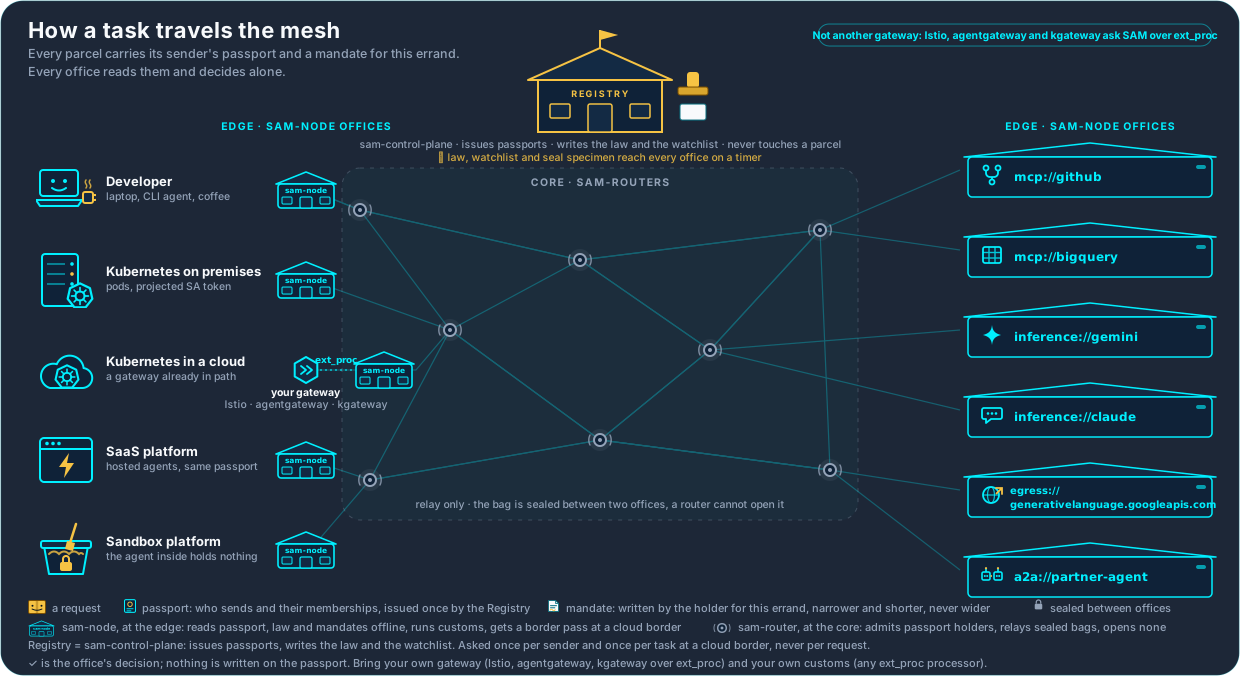
SAM moves tasks between environments that trust nothing on arrival, the way a courier network moves parcels between post offices:
| In the picture | In SAM |
|---|---|
| Parcel | One request: an MCP tool call, a chat completion, a BigQuery query, an A2A message. |
| Sender | The agent wherever it runs: a developer laptop, Kubernetes on premises or in a cloud, a SaaS platform, or a sandbox runtime. |
| Local post office | The sam-node next to the agent, or the native SDK (@sam-mesh/sdk, sam-mesh) inside its process. It checks the sender’s platform identity (projected service account token, GCE/Cloud Run metadata token, SPIFFE JWT-SVID, OIDC login) and obtains the waybill from the Registry. |
| Your gateway | Istio, agentgateway, Envoy AI Gateway, or kgateway where a cluster already runs one. It stays in the data path and asks the sam-node office over Envoy ext_proc, ext_authz, or RFC 8693 /oauth/token; the office issues the waybill, the gateway carries. |
| Waybill | The SAM Biscuit credential: who the sender (subject) is, through which office (actor_node) it travels, what standing roles it holds, and when it expires. |
| Mandate | An offline attenuation block (tar_block) appended at a task or sub-agent hop. It can only restrict; a sub-agent’s parcel carries one mandate more than its parent’s. |
| Sealed bag | The mutually authenticated, encrypted libp2p stream between two offices. Routers relay ciphertext across NAT, clusters, sites, and clouds and cannot open it. |
| Registry | sam-control-plane: verifies senders, stamps waybills (POST /register, POST /enroll, POST /token/exchange), distributes Datalog policy (GET /policies), issues the permits foreign borders recognize (POST /sts/token, /.well-known/openid-configuration, /jwks), and keeps the receipts. It never touches a parcel. |
| Destination office | The serving or egress sam-node for mcp://, inference://, a2a://, or egress://: verifies the waybill and every mandate again, runs customs, obtains the permit, and delivers. The operator chooses where it runs, hence from which network or jurisdiction traffic leaves. |
| Customs | Content inspection at the destination office: built-in policy facts, Google Cloud Model Armor, and Envoy ext_proc processors. |
| Permit | The destination credential: a federated cloud token exchanged from the Registry’s ES256 JWT for this sender and task, or a secret from the office vault. The agent never holds it. |
| Receipts | Structured audit logs at the Registry, at both offices, and at the cloud destination, joined by principal and sam_task. |
2. What problems SAM solves
In traditional cloud and service-mesh architectures, permissions are granted
ambiently to a workload identity (a Kubernetes Service Account, a cloud service
account, or a SPIFFE SVID spiffe://...). Workload identity authenticates the
caller, but AI agents need finer boundaries across five dimensions:
- A single agent service (such as a BigQuery analytics agent, a coding
orchestrator, or a customer support assistant) executes many concurrent or
sequential sessions with different least-privilege boundaries (for example,
read-only access to
dataset_Ain task 1 versus schema updates ondataset_Bin task 2). Workload identity proves which container is calling, while task authorization bounds what this specific request may do. - If an agent session exercises the full standing privileges of its user or workload identity, a prompt injection during a narrow task can access or mutate unrelated tools, models, or datasets. Narrowing each task credential before the task runs contains confused-deputy and prompt-injection blast radius.
- When a parent agent delegates a narrower sub-task to a child agent, it
attenuates its credential offline (
Token_2 = Attenuate(Token_1, TaskRule)) without round-tripping to the identity provider or minting new cloud service accounts on every hop. - An agent running on premises, on a laptop, or inside a sandbox calls cloud APIs (BigQuery, Vertex AI, S3, third-party MCP servers) without any static cloud key or ambient cloud service account inside that environment, and the cloud audit log records the actual user or workload principal rather than a shared node service account.
- Agents and tools run across laptops, on-premises clusters, and multiple
clouds behind NATs and firewalls. SAM routes and authorizes every call on the
service name (
mcp://,inference://,a2a://,egress://), never on an IP address.
Two-layer identity and authorization model
SAM separates caller attestation from task authorization:
| Layer | Question answered | Primitive | Role in SAM |
|---|---|---|---|
| 1. Workload / Subject & Channel Attestation | “Which workload or user initiated this request, and through which node is it travelling?” | OIDC ID tokens, Kubernetes projected SA JWTs, GCE/Cloud Run identity tokens, SPIFFE JWT-SVIDs, or Istio XFCC. | Verified at POST /register (node enrollment) or POST /token/exchange (caller delegation) to mint a Biscuit bound to the transport channel (client_peer_id, actor_node). |
| 2. Task / Session Authorization (TAR) | “What subset of standing permissions may this specific task or sub-agent hop exercise right now?” | SAM Task Biscuit (Block 0 Authority + appended tar_block blocks carrying api.TaskAuthorizationRule). | Attenuated offline across hops, enforced at every SAM Policy Enforcement Point (PEP), and translated into downscoped upstream cloud credentials by CloudTokenExchanger at egress. |
3. What SAM does not solve
SAM leaves several responsibilities to the surrounding platform.
3.1 OS, kernel, and container sandboxing
Confinement of the operating system, filesystem, and guest network namespace
belongs to the sandbox platform: NVIDIA OpenShell (Landlock, seccomp, network
namespaces, and its external secret-injecting proxy), Docker Sandbox
(docker sbx), or Kubernetes agent-sandbox (RuntimeClass: gvisor or kata
paired with a Kubernetes NetworkPolicy).
SAM provides the cryptographic task authority that those sandboxes consume:
control-plane-signed Delegated Session Biscuits (POST /token/exchange) and
sealed offline task attenuations (tar_block + Seal()).
3.2 Replacing an existing cluster gateway
Where a cluster already runs agentgateway, Istio, Envoy AI Gateway, or
kgateway, that proxy stays in place. Cluster gateways validate flat JWTs and
route local traffic, while sam-node plugs into them over Envoy ext_authz,
Envoy ext_proc, and RFC 8693 /oauth/token to add offline multi-hop task
attenuation, cross-network peer-to-peer routing, and cloud credential
brokering.
3.3 Using SPIFFE X509-SVID keys as libp2p member keys
Every mesh member (sam-node, sam-router, and native SDK peers) generates and
persists its own Ed25519 libp2p key pair. The peer ID derived from that key is
the primary key of the enrollment record, the value of node() and
client_peer_id(), the member in node:<peer_id> bindings, the holder of
router leases and discovery announcements, and the suffix of /p2p/<peer_id>
addresses.
SAM never uses an X509-SVID private key from the SPIFFE Workload API as the libp2p key:
| Property | SVID key as the libp2p key | SAM design |
|---|---|---|
| Algorithm | SPIRE issues EC P-256 or RSA keys, not Ed25519. The TypeScript/Python SDKs, mobile FFI, and portable MemberCredential state directories are Ed25519-only. | Ed25519 for every member. |
| Rotation | SPIRE rotates X509-SVIDs with a fresh key pair (every 30 minutes by default) and accepts no CSR on the Workload API. Every rotation would change the peer ID, drop active streams, and break node:<peer_id> bindings. | The Ed25519 key is stable for the life of the enrollment; the Biscuit is the rotating credential (POST /refresh). |
| Transport | The libp2p TLS handshake requires a self-signed certificate carrying the libp2p host-key extension, which an enterprise SVID cannot carry. | Noise or libp2p TLS with the member’s Ed25519 key. |
| Attestation | A key copied out of an SVID attests nothing to the control plane without an enrollment step. | Enrollment (POST /register) uses a platform OIDC token or SPIFFE JWT-SVID as attestation evidence for the member’s Ed25519 key. |
3.4 Fine-grained cloud IAM where the cloud provider has no per-task API
Where each layer enforces depends on what the destination cloud API supports:
| Destination class | Border credential | Per-task narrowing enforced today | Residual boundary |
|---|---|---|---|
| Google Cloud APIs (BigQuery, Vertex AI, Cloud Storage) | Control-plane ES256 JWT federated via Workload or Workforce Identity Pool (oidc_federation), optional SA impersonation with narrowed scopes | Mesh PEP on host, HTTP method, and REST path (BigQuery REST paths carry project, dataset, and table; Vertex paths carry the model); OAuth scopes; CEL attribute conditions on act.sub; principalSet bindings on google.groups (sam_roles); Credential Access Boundaries for Cloud Storage. | A body-level reference inside an allowed REST path (for example, a SQL string in BigQuery jobs.insert referencing a second table) is bounded by the federated principal’s standing IAM ceiling until a public Google per-task token API exists. |
AWS (aws_assume_role) | Control-plane ES256 JWT via AssumeRoleWithWebIdentity | Inline AWS session policy compiled from the intersected TaskAuthorizationRule chain (allowed_permissions $\rightarrow$ Action, allowed_resources $\rightarrow$ Resource) intersected with the role’s standing IAM policy. | AWS 1-hour role-chaining limit (sub-agent hops re-assume from the egress node rather than chaining AWS STS credentials) and packed session policy size limit. |
| API-key services (Gemini Developer API, OpenAI, Anthropic, GitHub PATs) | static_secret from the egress node’s --secrets-dir | Mesh PEP on service name, HTTP method, REST path (model name), MCP tool name, and task TTL. | Static API keys cannot be downscoped at the upstream provider; the egress node never exposes the key to the caller. |
External agents (a2a://) & third-party MCP servers | Control-plane JWT if the party federates with the SAM OIDC issuer; otherwise static_secret | Mesh PEP plus whatever scope/claim checks the remote authorization server enforces. | Depends on the remote party’s authorization server. |
3.5 Non-HTTP protocols without TLS SNI
SAM terminates and inspects HTTP/1.1 and HTTP/2 (REST, JSON-RPC MCP, A2A, SSE)
and supports raw TCP carrying TLS (PostgreSQL, Cloud SQL, AlloyDB, Redis, SSH)
via named CONNECT tunnels (EGRESS_MODE_TCP). It does not proxy raw UDP,
QUIC/HTTP/3, ICMP, or raw IP frames, and it does not inject brokered credentials
into opaque TCP tunnels. For TCP tunnels, the client authenticates end-to-end
over the spliced TLS stream while the egress node enforces the ports
allow-list and TLS ClientHello SNI match.
4. How SAM solves it
4.1 Platform attestation, binding wildcards, and workload containment
Node attestation sources (TokenSource)
sam-node and sam-router consolidate headless enrollment and continuous
refresh re-attestation behind the
TokenSource
interface (FetchToken(ctx)):
| Environment | Token source | How it works |
|---|---|---|
| Kubernetes | --jwt-path (FileTokenSource) | Reads a projected service account token (aud = control plane audience), rotated by kubelet, at enrollment and on every POST /refresh. |
| GCE VMs & Cloud Run | --cloud-provider=gcp|auto (GCPMetadataTokenSource) | Queries http://metadata.google.internal/computeMetadata/v1/instance/service-accounts/default/identity?audience=<aud>&format=full with Metadata-Flavor: Google at enrollment and on every POST /refresh. |
| VMs & bare metal with SPIRE (or multi-cluster SPIFFE) | --jwt-path + spiffe-helper (FileTokenSource) | spiffe-helper fetches a JWT-SVID from the SPIFFE Workload API and rotates the file on disk; sub is spiffe://<trust-domain>/<path>. |
| OAuth 2.0 service clients | --oidc-issuer + --client-id + --client-secret-path (ClientCredentialsTokenSource) | Runs an OAuth client-credentials grant at enrollment and on every POST /refresh. |
| TypeScript & Python SDKs | jwtPath / jwt_path or jwt callback (JwtSource) | Re-reads the file or invokes jwt: () => string | Promise<string> / Callable[[], str] at enrollment and on every refresh(). |
An interactive human login with --join --offline-access
(RefreshTokenSource) also implements TokenSource, but ResolveTokenSource
marks it continuous=false: the stored OIDC refresh token is not redeemed on
routine POST /refresh calls and is used only when /refresh fails and the
node falls back to re-enrollment.
Prefix and suffix wildcards in PolicyBinding.members
Claim-backed binding members (user:, email:, group:, idp_role:) accept
either an exact value, a single trailing * ($v.starts_with("<prefix>")), or
a single leading * ($v.ends_with("<suffix>")), evaluated identically in
control-plane role resolution (resolveRoles) and node-side Datalog generation
(api.BuildPolicyRules):
user:system:serviceaccount:sam-nodes:*matches any service account in namespacesam-nodes.user:spiffe://acme.example/ns/prod/*matches any SPIFFE workload under that path prefix.email:*@my-project.iam.gserviceaccount.commatches any Google Cloud service account inmy-project.
To prevent accidental open bindings and Datalog rule injection:
- Bare
<prefix>:*(such asuser:*oremail:*) is rejected as a disguisedsam:system:authenticated. - Interior wildcards (
a*b) and wildcards onnode:<peer_id>are rejected. ValidateBindingMemberandValidateRoleNamereject",\, and control characters while permitting spaces,;, and UTF-8 (such asgroup:Engineering Team).BuildPolicyRulesnever skips exact members on charset grounds and quotes wildcard string literals withstrconv.Quote.
Workload issuer containment (--workload-issuer)
Without separation between human and workload OIDC tokens, any workload token
from a trusted --issuer could call /user/bootstrap-tokens and mint
sam:role:node bootstrap tokens.
--workload-issuer (a subset of --issuer, automatically added to the OIDC
verifier pool) classifies tokens as workload identities:
- A bare
<issuer>entry marks every token from that issuer (for example, a Kubernetes cluster issuer or SPIRE OIDC Discovery Provider) as a workload. - An
<issuer>=<email-suffix>entry (such ashttps://accounts.google.com=.gserviceaccount.com) marks tokens from a shared issuer whoseemailends with that suffix as workloads. GCE VM metadata tokens requested withformat=fullalso carry agoogle.compute_engineclaim that is classified automatically as a workload; Cloud Run metadata tokens do not carrygoogle.compute_engineand therefore require thehttps://accounts.google.com=.gserviceaccount.comsuffix form. - Workload tokens are accepted at
POST /register,POST /refresh, andPOST /token/exchange, and refused with403 Forbiddenat/user/*and/oauth/authorize.
Continuous attestation on POST /refresh and --workload-session-ttl
When sam-node, sam-router, or an SDK member has a continuous token source,
it includes a fresh platform JWT in TokenRefreshRequest.jwt on every Biscuit
refresh:
HandleRefreshverifies the JWT against the OIDC verifier pool, confirms thatoidcIdentityKey(iss|sub) matches the enrolled node record, updatesClaimsJSONand the sessionExpiresAtin place, and re-resolves the node’s roles against the current policy.--workload-session-ttldefaults to48h(compared with2160h/ 90 days for human--oidc-session-ttl), giving the node a bounded window to survive transient metadata or token-file errors before its session expires if no fresh JWT is presented.
4.2 Safe Biscuit attenuation (tar_block) and single-pass verification
In biscuit-go, datalog.WithMaxFacts and datalog.WithMaxIterations bound
rule evaluation, not check if queries: a holder-authored block with 0 rules
and a multi-variable cross-join check (check if a($x), b($y), c($z)) can
trigger exponential backtracking inside check.Run(). Furthermore, if an
appended block carried both Datalog checks and a serialized protobuf, a
malicious holder could craft a token where the Datalog check passes at the mesh
PEP while a broader protobuf is forwarded to CloudTokenExchanger.
SAM never evaluates holder-authored Datalog rules or checks.
Every appended block (block_idx >= 1) contains 0 Datalog rules, 0 Datalog
checks, and 1 Datalog fact of the form
tar_block("<unpadded-base64url-serialized api.TaskAuthorizationRule>").
Before constructing a Datalog authorizer, UnmarshalInbound in Go
(biscuit-go), TypeScript (@biscuit-auth/biscuit-wasm), and Python
(biscuit_auth) inspects blocks 1..k and enforces identical bounds:
MaxAttenuationBlocks = 8MaxTARBytes = 4096(serialized protobuf bytes per block)MaxRulesPerTAR = 16MaxEntriesPerTARList = 64(perallowed_services,allowed_tools,allowed_methods,allowed_paths,allowed_permissions,allowed_resources)MaxTARNameLength = 128(printable ASCII)- Single-line fact syntax matching
^tar_block\("([A-Za-z0-9_-]+)"\);?\s*$
The verifier decodes the []*api.TaskAuthorizationRule chain in a single pass
and evaluates it in host code alongside Block 0’s Datalog policy. Within a
single TaskAuthorizationRule, a request matches if it satisfies at least one
TaskRule (an empty rules list denies everything). Across blocks 1..k,
semantics are strict intersection (logical AND): the request must satisfy
Block 0 Datalog RBAC, arrive before every block’s expire_time, and match at
least one TaskRule in every appended block.
Per-service-type PEP matching semantics
| Service type | allowed_services | operation.allowed_tools | operation.allowed_methods & allowed_paths | operation.allowed_permissions & allowed_resources |
|---|---|---|---|---|
mcp://<name> | Enforced on stream handshake & HTTP | Enforced on tools/call (params.name). At stream open (initialize, tools/list), tool name is not yet present so allowed_tools does not block opening the stream. | Enforced if the rule sets allowed_methods or allowed_paths (a raw libp2p stream has no HTTP facts, so HTTP constraints deny raw streams). | Ignored by wire PEP (consumed by CloudTokenExchanger). |
inference://<name>, a2a://<name> | Enforced on HTTP request | A rule with non-empty allowed_tools requires an MCP tool name and does not match plain HTTP requests. | Enforced against request Method and Path when non-empty. | Ignored by wire PEP. |
egress://<name> | Enforced on HTTP request & TCP CONNECT | Must be empty for an HTTP or TCP rule to match. | Enforced against Method and Path when non-empty (a TCP CONNECT tunnel has Method: "CONNECT" and Path: "", so any rule with allowed_paths denies a tunnel). | Intersected across blocks 1..k and translated by CloudTokenExchanger at egress. |
system://<name> | Enforced on stream handshake | Enforced when a tool call is made. | Same as mcp://. | Ignored by wire PEP. |
4.3 Subject vs. actor (actor_node), stateless exchange, and revocation
When a sam-node exchanges a caller’s platform token on their behalf, the
resulting Biscuit separates the node that owns the transport channel
(actor_node) from the subject whose identity is being exercised (user,
email, role), matching RFC 8693 (sub vs. act).
A Member Biscuit (POST /register, POST /enroll, POST /refresh) is minted
for an infrastructure node, router, or native SDK member and carries
node("<peer_id>"), client_peer_id("<peer_id>"), user("<subject>"),
role("<role>"), and expiration(<time>).
A Delegated Session Biscuit (POST /token/exchange, POST /oauth/token) is
minted statelessly on the control plane with zero database writes:
client_peer_id("<origin_node_peer_id>")binds the token to the origin node’s libp2p connection (check if client_peer_id($id), connection_peer_id($id)), so an exfiltrated token cannot be replayed from another peer.actor_node("<origin_node_peer_id>")records the acting node for audit logs,act.subin outbound border JWTs, andext_procattributes. No policy rule grants permissions onactor_node.user(...),email(...),group(...),idp_role(...), androle(...)are resolved strictly from the caller’ssubject_token.- No
node()fact is minted, which preventsnode:<peer_id>policy bindings on the origin node from leaking to the delegated caller.
Before handing a task token to an untrusted leaf process or sandbox, the holder
calls Seal(), discarding the ephemeral next-block key so no further blocks can
be appended.
Revocation operates at two levels. Root-prefix revocation (GET /revocations)
uses b.RevocationIds()[0] to identify the authority block, so revoking a root
token or banning a peer or user at the control plane invalidates both the root
Biscuit and every offline-attenuated child derived from it across the mesh.
Local task revocation (POST /oauth/revoke) lets an orchestrator revoke a
specific child Task Biscuit at the local sam-node as soon as a task finishes,
caching RevocationIds()[last] in the node’s revocation LRU until the token’s
expire_time.
4.4 Two-token model: the control plane as OIDC issuer
Inside the mesh, credentials are Biscuits; at both external borders,
credentials are standard JWTs. For the outbound border, sam-control-plane acts
as a standard OIDC issuer:
| Element | Implementation |
|---|---|
| Signing key | ES256 (P-256 ECDSA), rotated with overlap and kid (internal/controlplane/sts.go). Google Cloud and AWS STS accept RS256 and ES256, not Ed25519; Ed25519 remains the Biscuit authority key. |
| Discovery & JWKS | GET /.well-known/openid-configuration and GET /jwks on the control plane. For air-gapped or private control planes, the JWKS can be uploaded directly to the cloud workload identity pool. |
| Mint endpoint | POST /sts/token (protobuf over HTTP): accepts the caller’s Biscuit and destination name, verifies the Biscuit and the full tar_block chain against egress://<destination>, writes a Border Crossing audit log, and returns a short-lived ES256 JWT. |
| JWT claims | iss = control plane URL; sub = caller principal (email or issuer#subject); act = {"sub": "<egress_node_peer_id>"}; aud = destination audience from EgressDestination (one audience per destination); sam_roles = authority-block roles (mapped to google.groups for principalSet bindings); sam_task = innermost TaskAuthorizationRule.name (audit-only). |
| TAR narrows, never selects | Nothing in a holder-appended tar_block can select a broker, role ARN, service account, or audience; every claim that cloud IAM binds on (sub, sam_roles, act.sub, aud) comes from Block 0 or the control plane’s EgressDestination policy. |
| Caching | The egress node caches minted border JWTs and upstream cloud tokens by Biscuit SHA-256 digest, keeping the control plane off the per-request hot path. |
4.5 Proof of possession across the three surfaces
| Surface | Mechanism | What it binds | Replay defense |
|---|---|---|---|
| libp2p data path (node-to-node, node-to-router) | Channel binding: Block 0 client_peer_id must equal the connection_peer_id authenticated by the libp2p Noise or TLS handshake. | The transport private key | None needed; the token is unusable on any other connection. |
Control plane mesh protocol (/enroll, /enroll/status, /register, /refresh, /routers/lease, /token/exchange, /sts/token) | Ed25519 signature over sam:<endpoint>:<peer_id>:<challenge_unix_ms>, carried in protobuf fields (challenge_unix_ms, challenge_signature) or X-Sam-Challenge-Ts / X-Sam-Challenge-Sig on GET /enroll/status. | Endpoint name, peer ID, timestamp | 5-minute freshness window (challengeMaxAge); /refresh additionally redeems only the last Biscuit issued to the peer. |
Control plane read & report endpoints (/policies, /egress, /revocations, /nodes/catalog) | Bearer Member Biscuit of an admitted node (admittedNode). | Enrolled node credential | Bounded by Biscuit TTL and ban/revocation list. |
OAuth 2.1 external client surface (/oauth/authorize, /oauth/token, /mcp over HTTPS) | Authorization Code + PKCE (S256) on the code grant. The client_peer_id of the minted Biscuit is the calling node’s when a node calls, otherwise the actor_peer_id form parameter or the control plane’s own peer ID (resolveDefaultActorPeer). | A claimed peer ID (the Biscuit is a bearer token on the HTTPS /mcp hop unless sender-constrained with DPoP; see §5.2) | Single-use authorization codes with PKCE verifier check on the code exchange; none on the resulting bearer Biscuit. |
4.6 Gateways, egress credential brokers, content inspection, and TCP tunnels
Gateway integration (sam-node)
sam-node exposes three standard gateway interfaces on its HTTP listener
(--bind-addr):
- Envoy
ext_authz(/ext_authzand/envoy.service.auth.v3.Authorization/Check) evaluates standing Datalog policy andtar_blockrules on incoming EnvoyCheckRequestcalls, accepts verified SPIFFE IDs fromAttributeContext.Source.PrincipalorX-Forwarded-Client-Cert(XFCC) on trusted proxy listeners, and injects brokered upstream credentials (Authorization: Bearer ...,X-Sam-Principal,X-Sam-Task-Id). - Envoy
ext_proc(/envoy.service.ext_proc.v3.ExternalProcessor/Process) inspects buffered JSON-RPC request bodies sooperation.allowed_toolson MCPtools/callis enforced before injecting the upstream credential. - RFC 8693 Token Exchange (
POST /oauth/token) and MCP OAuth 2.1 acceptgrant_type=urn:ietf:params:oauth:grant-type:token-exchangewith a JWT or Biscuitsubject_tokenand optionalTaskAuthorizationRule(inoptions,scope, orresource), and serve RFC 9728/.well-known/oauth-protected-resourcepointing unauthenticated MCP clients to the control plane’s OAuth 2.1 Authorization Server.
On /sam/{peer}/{type}/{svc}/..., the Authorization header is reserved for
the destination service’s own credential and passes through untouched; callers
pass their SAM Biscuit or JWT in X-Sam-Authentication. Transparent JWT
exchange on Authorization: Bearer <JWT> applies only to /mcp and /v1/*.
Content inspection at the egress node (inspection.inspectors)
Requests travel as ciphertext through routers and are decrypted at the egress
node selected by served_by. Inspection is configured on EgressDestination
and runs before the credential broker injects the upstream secret, so an
inspector never sees destination credentials:
- Built-in policy facts expose
host(),port(),method(),path(), and the MCP tool name fromtools/callto Datalog andTaskAuthorizationRuleevaluation. - Google Cloud Model Armor (
model_armor) callssanitizeUserPromptand (inBUFFEREDmode)sanitizeModelResponseover HTTPS for Gemini, OpenAI chat, MCPtools/call, and A2A payloads, blocking findings with403andProxy-Statusand applying Sensitive Data Protection de-identification replacements. - Envoy
ext_proccallouts (ext_proc) stream headers, bodies, and trailers over standard-library HTTP/2 gRPC (using trimmed protos vendored underthird_party/envoy/with zero extra rootgo.moddependencies) withProcessingRequest.attributes["sam"]populated (principal,roles,actor_node,task,service,destination). Any mutation toAuthorization,Host,:authority, orX-Sam-*by the processor is refused. - Operator inspection chains (
preserve_host,forward_context) route through an explicit outbound proxy (such as Secure Web Proxy oragentgateway) while preserving the destinationHostheader and optionally forwardingX-Sam-Principal,X-Sam-Roles, andX-Sam-Task.
Named TCP tunnels (EGRESS_MODE_TCP)
When mode: EGRESS_MODE_TCP and a non-empty ports allow-list are set on an
EgressDestination, the node accepts CONNECT <name>:<port> and
sam-node forward egress://<name>:<port> <local-addr>. Before splicing the TCP
stream, the egress node peeks at the TLS ClientHello and refuses the
connection if the SNI does not match <name> or if Encrypted Client Hello (ECH)
hides the SNI.
4.7 Integration blueprints
Blueprint 1: NVIDIA OpenShell (zero-credential sandbox)
flowchart LR
  subgraph OpenShell["NVIDIA OpenShell Sandbox (Landlock + seccomp + netns)"]
    Harness["Unmodified Agent Process<br/>(Holds ZERO credentials)"]
  end
  subgraph Host["Host / Orchestrator Boundary"]
    OSProxy["OpenShell Egress Proxy<br/>& Secret Injector"]
    SamNode["Local sam-node Gateway"]
  end
  Mesh(["SAM Mesh & Providers"])

  Harness -- "Plain HTTP to sam-node:8080/mcp & /v1" --> OSProxy
  OSProxy -- "Injects X-Sam-Authentication:<br/>Bearer <Sealed-Task-Biscuit>" --> SamNode
  SamNode -- "X-Sam-Biscuit: <Sealed-Task-Biscuit>" --> Mesh
The orchestrator exchanges and attenuates a Task Biscuit via POST /oauth/token
with seal=true and registers it in OpenShell’s external proxy secret injector.
The sandboxed process holds zero credentials in its environment or filesystem.
Blueprint 2: Docker Sandbox (docker sbx) & Kubernetes agent-sandbox
When the sandbox container holds a token (SAM_TASK_TOKEN or a Kubernetes
projected service account JWT) to authenticate to a local or cluster
sam-node:
- The token is sealed (
Seal()) and narrowed to the single task’sTaskAuthorizationRule. - Channel binding (
client_peer_id) ties the token to the originsam-node’s peer ID, so an exfiltrated token cannot be used from another host or node. - A short
expire_timeand explicit revocation (POST /oauth/revokeon container exit) bound the lifetime to the task run.
Blueprint 3: agentgateway / Istio service mesh
Workloads authenticate to agentgateway or Istio via mTLS SPIFFE XFCC or a
Task Biscuit; the gateway calls sam-node over ext_authz, ext_proc, or RFC
8693 /oauth/token for local policy enforcement and routes cross-cluster MCP,
A2A, and cloud egress calls through sam-node.
Blueprint 4: End-to-end cloud egress (BigQuery read-only task & sub-agent hop)
sequenceDiagram
    autonumber
    participant Origin as Origin sam-node / SDK agent
    participant Egress as Egress sam-node (egress://bigquery.googleapis.com)
    participant CP as SAM Control Plane (OIDC issuer)
    participant STS as Provider STS (sts.googleapis.com / sts.amazonaws.com)
    participant API as Destination API

    Origin->>Egress: libp2p stream GET /egress/bigquery.googleapis.com/bigquery/v2/...<br/>AuthFrame.biscuit = <Task Biscuit (authority + tar_block 1..k)>
    Note over Egress: 1. Authorize: CP signature, actor binding,<br/>standing policy for the subject, TAR chain on<br/>service(), host(), port(), method(), path()
    Egress->>CP: 2. POST /sts/token { biscuit, destination } (cache miss on biscuit digest)
    Note over CP: Verifies the Biscuit and TAR chain again;<br/>mints ES256 JWT: sub=principal, act=egress node,<br/>aud=destination audience, sam_task, exp=minutes
    CP-->>Egress: 3. JWT
    Egress->>STS: 4. RFC 8693 exchange: subject_token=JWT<br/>(Google: pool provider; AWS: AssumeRoleWithWebIdentity + session Policy from TAR)
    STS-->>Egress: 5. Short-lived destination credential (cached by biscuit digest)
    Egress->>API: 6. Request with the destination credential; TLS originated here
    Note over API: 7. Provider IAM evaluates the federated principal's standing grants<br/>(and the session policy on AWS)
    API-->>Egress: 200 OK
    Egress-->>Origin: 200 OK
5. What is left out or deferred on purpose
5.1 Nonce and body-hash binding on control-plane HTTP requests
POST /enroll, GET /enroll/status, POST /register, POST /refresh,
POST /token/exchange, and POST /sts/token verify an Ed25519 signature over
sam:<endpoint>:<peer_id>:<challenge_unix_ms> within a 5-minute clock window
(challengeMaxAge), while /policies, /egress, /revocations, and
/nodes/catalog authenticate the caller via its bearer Member Biscuit.
Because the signed text does not yet carry a server-tracked random nonce or
request-body SHA-256 hash, TLS (https://) is mandatory for every remote
control plane (AllowInsecureControlPlane is restricted to loopback or
explicitly trusted networks). Extending the proof message with a random nonce,
an optional server nonce for skewed clocks, and a request-body SHA-256 hash across
all credentialed control-plane endpoints is a self-contained future hardening
step.
5.2 Optional DPoP (RFC 9449) at the OAuth 2.1 border
Inside the mesh, libp2p channel binding (client_peer_id == connection_peer_id)
provides per-connection proof of possession between nodes. An external MCP
client, however, reaches a node’s /mcp ingress over HTTPS with no libp2p
channel, so the Biscuit minted for it at /oauth/token carries a claimed
client_peer_id and is a bearer token on that HTTPS hop.
DPoP (RFC 9449) is the standard mechanism to sender-constrain that external
OAuth hop: when a client sends a DPoP header at /oauth/token, the control
plane verifies the proof (htm, htu, iat, jti), mints the key thumbprint
as client_key_thumbprint("<jkt>") in the Biscuit authority block, and returns
token_type: DPoP, and the node’s /mcp ingress verifies the DPoP proof with
ath over the Biscuit and checks
client_key_thumbprint($t), connection_key_thumbprint($t). Because the MCP
authorization specification does not require DPoP and off-the-shelf MCP clients
(Claude Code, Gemini CLI, Cursor, VS Code) only send Authorization Code + PKCE
today, DPoP is optional (dpop_bound_access_tokens_required: false) and a
Biscuit minted without a DPoP proof remains a bearer token at /mcp.
5.3 No built-in Azure or AWS IMDS node enrollment TokenSource
GCE and Cloud Run provide a standard OIDC JWT from the instance metadata server
(--cloud-provider=gcp|auto). AWS EC2 IMDS issues SigV4 credentials and a
PKCS7 document rather than an OIDC JWT, and Azure IMDS requires a
tenant-registered Entra Application ID URI (resource). On AWS, Azure, and bare
metal without Kubernetes projected tokens, SPIRE (aws_iid, azure_msi,
tpm_devid) with spiffe-helper writing a JWT-SVID to --jwt-path is the
single portable path.
5.4 No X509-SVID mTLS termination on the control plane
Enrolling via X509-SVID mTLS would require the control plane (and any ingress
load balancer in front of it) to terminate mTLS against the SPIFFE trust
bundle. JWT-SVIDs over --jwt-path work through standard HTTPS load balancers
and CDNs with zero TLS termination coupling.
5.5 Model Armor streaming modes
Model Armor’s unary REST API (sanitizeUserPrompt and sanitizeModelResponse)
is called using the Go standard library without vendoring google/api gRPC
protos. Destinations that stream responses choose between
RESPONSE_INSPECTION_BUFFERED (inspect the complete response before release)
and RESPONSE_INSPECTION_REQUEST_ONLY (inspect the prompt and stream the
response directly).
6. Summary of security invariants
sam-control-planeis the customer-owned OIDC issuer for cloud egress, using a KMS/HSM-attributable ES256 signing key, short JWT lifetimes, one audience per destination, CEL attribute conditions restrictingact.subto enrolled egress nodes, and joined audit logs (sub+sam_task).sam-control-planestays off the per-request hot path: nodes cache unattenuated, unsealed Delegated Session Biscuits bySHA-256(subject_token_type + "|" + subject_token)and cache minted border JWTs and upstream cloud tokens by Biscuit SHA-256 digest.- Appended Biscuit blocks are treated as untrusted bytes: structural bounds
(
MaxAttenuationBlocks = 8,0rules,0checks,1tar_blockfact,MaxTARBytes = 4096) run before any Datalog authorizer is constructed in Go, TypeScript, and Python. - Egress nodes prevent confused-deputy attacks by stripping caller
Authorization,Cookie, andX-Sam-*headers, running content inspectors before credential injection, refusing inspector mutations toAuthorization,Host,:authority, orX-Sam-*, and never allowing a holder-authored TAR block to select a broker, role, or audience. - Workload issuers configured via
--workload-issuercan enroll, refresh, and exchange credentials on the mesh surface, and are refused at/user/*and/oauth/authorizeso a compromised workload cannot register as a human user or mint bootstrap tokens. - Binding member values and role names reject control characters,
", and\while permitting spaces,;, and UTF-8;BuildPolicyRulesnever skips exact members on charset grounds and quotes wildcard string literals withstrconv.Quotebefore rendering.starts_with(...)or.ends_with(...)Datalog rules.